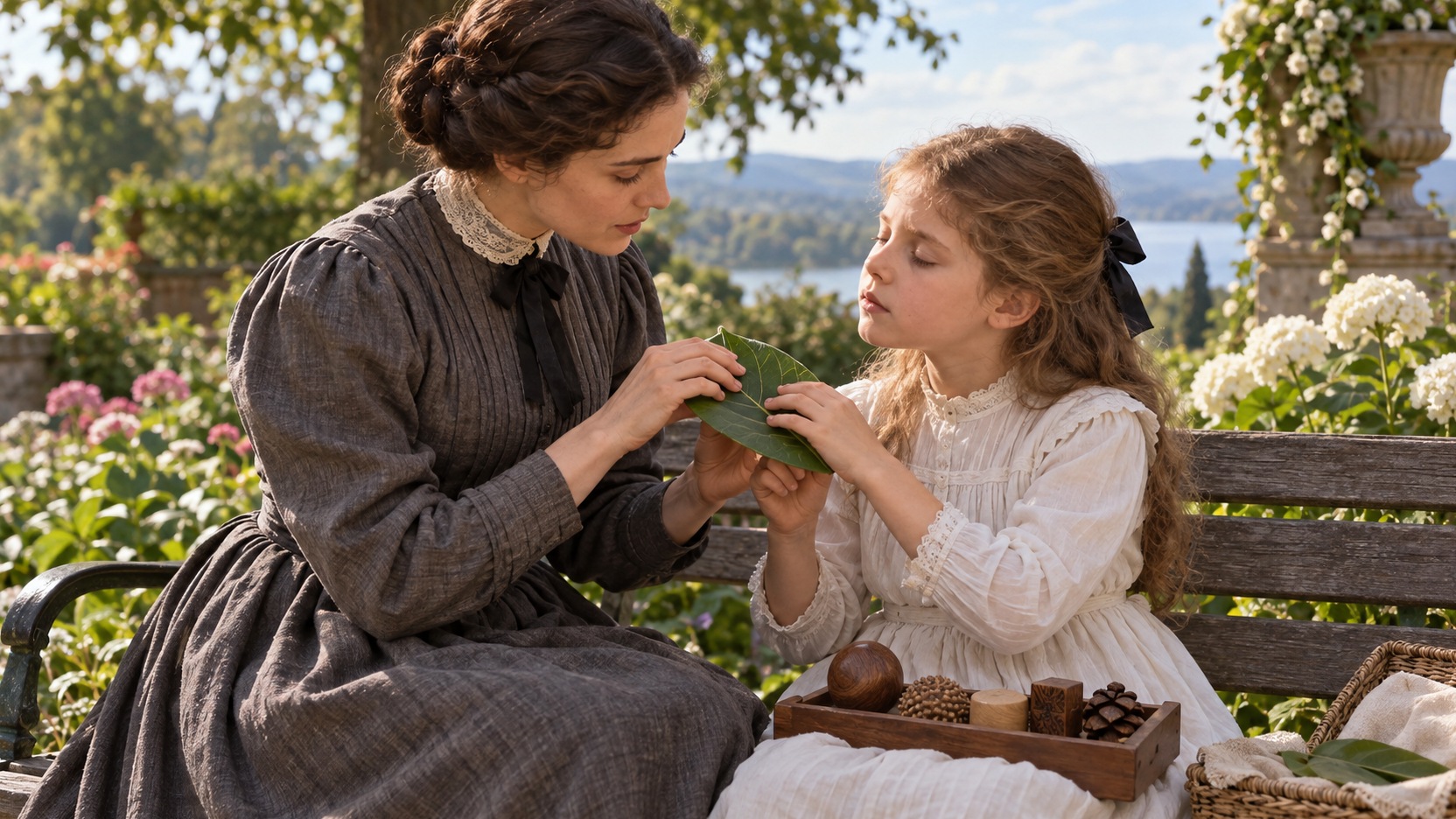
The famous breakthrough opened a relationship that continued for years
The familiar account of Anne Sullivan and Helen Keller often gathers around a single moment: flowing water, fingerspelling, and a new understanding of language. That moment matters, but a teaching relationship cannot be understood only through its most dramatic scene. Sullivan arrived with her own educational experience and preparation. Keller brought curiosity, intelligence, and an active desire to communicate. Their work continued through further learning, study, and changing circumstances. Looking beyond the breakthrough helps readers see education as a sustained relationship involving access, interpretation, and the learner’s participation. It also prevents a famous story from becoming a simplistic claim that determination alone can replace the methods and support a person needs to learn.
A: It brings the learner’s perspective into the comparison, while each account still needs attention to its authorship, date, and purpose.
A: She had studied at Perkins and prepared for the role before traveling to the Keller family.
A: The educational significance concerns meaning, not simply reproduction of a physical pattern.
A: Credit her exploration, intellectual work, and continuing participation in learning.
A: Accessible assistance and intellectual ownership can coexist and should both be described accurately.
A: No. Contemporary support requires individualized understanding and appropriate expertise.
A: It offers materials that can be examined for specific claims, perspectives, and historical context.
A: Responsive persistence includes review and change when the learner’s needs call for it.
A: It selects and interprets events rather than supplying the full continuing relationship.
A: How accessible communication and sustained support enable a person’s meaningful participation in learning.
Understand the people before the iconic scene
Helen Keller was born in Tuscumbia, Alabama, in 1880 and became deafblind following an illness in early childhood. Anne Sullivan had studied at Perkins School for the Blind and was herself visually impaired. The Perkins account of Sullivan explains her educational background and preparation for teaching Keller. These circumstances matter because the relationship brought together two people with experience and capability, not an all-powerful teacher and an empty-minded child.
A historical account should use language that recognizes Keller’s existing ways of exploring and communicating. Difficulty accessing other people’s language did not mean absence of thought. Sullivan’s task concerned making communication and further learning more accessible. That distinction changes how the story’s central achievement is understood.
Notice the preparation behind Sullivan’s appointment
The American Foundation for the Blind’s account includes the 1886 letter in which Perkins director Michael Anagnos invited Sullivan to consider the position with the Keller family. The contact grew from a search for educational help. The surviving letter places the famous relationship within a network of people and institutions. It was not a spontaneous encounter outside an educational context.
Distinguish accessible language from repeated movement
Sullivan used fingerspelling in Keller’s hand to connect language with experience. Repeating a hand pattern and understanding what it refers to are different forms of learning. The famous breakthrough is significant because it concerns meaning. A reader should look beyond the physical action to the relation between an experience, a symbol, and an understanding that can be used elsewhere.
This distinction is useful when interpreting any educational demonstration. A learner may reproduce an action before understanding its purpose. A teacher needs evidence that meaning is developing, not simply that a sequence has been repeated. The general principle does not prescribe a modern deafblind teaching method. It helps explain why an account of understanding is different from a description of movement.
A dramatic portrayal may emphasize the visible action because it can be shown on screen. The educational work also includes attention to what the learner perceives and how a connection becomes meaningful. Those less visible elements deserve consideration. They make the breakthrough understandable without treating it as an unexplained miracle.
Read the water-pump episode within its educational context
The Perkins biography of Keller recounts Sullivan’s arrival in March 1887 and the water-pump episode. It describes fingerspelling associated with familiar objects and continued language learning afterward. The episode therefore belongs to an ongoing effort to make communication accessible. Its importance should not imply that all learning began and ended at the pump.
Consider what an account of a breakthrough highlights. It selects a moment when a change becomes recognizable. Before it, there is preparation and activity; afterward, there is further learning. The moment can be real and significant while still being incomplete as an explanation of the relationship.
Keep Keller’s participation visible
Keller’s exploration and learning are central to the achievement. She did not merely receive a teacher’s insight. She made connections, pursued language, and later undertook substantial intellectual work. The relationship should be described in a way that credits those contributions. Admiration for Sullivan should not remove Keller’s agency from the account.
This is especially important in disability history. A narrative can unintentionally present a disabled person chiefly as the object of another person’s generosity. That frame makes the supporter visible while leaving the learner’s decisions and work in the background. A more careful reading examines what each person contributes and how access changes the opportunities available.
It also avoids turning one person into a universal symbol. Keller’s experience is historically significant, but it does not represent every deafblind person’s needs or path. People differ in communication, education, circumstances, and preferences. The story deserves attention as a particular relationship rather than as a required script for everyone else.
Readers can ask how a source presents Keller’s point of view. Does it include her own account, describe her actions, or speak only about her through others? Those choices influence interpretation. Including the learner’s perspective makes the history richer and helps resist a one-sided image of teaching.
Recognize years of learning beyond an early childhood moment
The American Foundation for the Blind’s biography records Keller’s later education, including her graduation from Radcliffe in 1904. The interval between the early language breakthrough and the degree is a reminder of sustained study. A milestone opens possibilities; it does not eliminate the need for further knowledge, practice, and accessible support.
See access as part of education rather than an optional kindness
Learning requires a way to engage with information, communicate, and participate in the relevant activity. When the usual format is inaccessible, capability may remain hidden from the people judging it. This general observation helps frame the historical relationship. The question is not simply whether the learner is motivated, but whether the educational environment makes meaningful participation possible.
For a modern educator, the practical response is to seek appropriate expertise and understand a learner’s communication and access needs. A historical biography cannot supply an individualized support plan. Contemporary methods and decisions belong to qualified practice with the person and relevant professionals. The story can motivate attention to access without replacing that work.
Do not confuse support with lack of intellectual ownership. A learner can use substantial assistance to access material while doing demanding reasoning themselves. The forms of assistance and the work being completed should be described accurately. This distinction is essential when interpreting an achievement involving accessible communication.
Examine Sullivan’s development as a teacher
The American Foundation for the Blind’s Sullivan exhibit draws on surviving materials and acknowledges that much of her life is known through others’ accounts. That is a useful historical limitation to keep in view. The celebrated teacher’s public image should not be mistaken for complete access to her private experience or every decision she made.
A teacher’s methods can evolve through attention to the learner. Historical reading should look for that development instead of assuming an unchanging technique explains everything. Where the evidence is incomplete, avoid inventing a smooth story. A thoughtful account can recognize expertise and learning without claiming certainty about undocumented moments.
Distinguish the historical relationship from a dramatic adaptation
Stories associated with The Miracle Worker often foreground the conflict and breakthrough of the early period. Dramatic form makes a selected part of a life emotionally immediate. A reader should distinguish that portrayal from the continuing relationship described in historical records. The adaptation can introduce the subject without providing a full chronology.
When comparing sources, choose a specific feature to investigate. You might examine how the teacher’s preparation is represented or how the learner’s perspective appears. General declarations that a portrayal is entirely accurate or entirely false are less useful. Careful comparison makes the evidential issue more precise.
Also consider the language of miracle. It expresses the magnitude of the event in public memory, but it can obscure the educational work that made communication possible. An account can preserve wonder while explaining methods, preparation, and participation. The two need not be mutually exclusive.
This distinction matters for expectations placed on teachers and learners today. A dramatic breakthrough should not become a timetable by which every relationship is judged. Development can take different forms and proceed at different rates. Current support should be guided by the person’s needs and appropriate evidence rather than by a famous scene.
Use archives to ask more precise historical inquiries
Perkins’ Keller and Sullivan collections include correspondence and other historical materials. Such resources offer a route beyond a short biography. They can help readers investigate how accounts were created and which perspectives survive. An archive should be approached with a specific inquiry rather than as a collection that automatically supplies one complete interpretation.
Pay attention to authorship, date, recipient, and purpose. A letter written to explain progress may emphasize different matters from a later memoir. An institutional description may frame a relationship through the organization’s history. These differences do not make the sources useless. They help establish what each can support.
Avoid extracting a universal technique from one life
A famous educational relationship can suggest principles worth examining, such as attention to communication and sustained learner participation. It cannot determine the right method for every person or setting. Applying a historical example requires caution about differences in knowledge, tools, rights, and professional practice. The present-day decision needs contemporary expertise.
Similarly, the story should not encourage a teacher to persist with an unsuitable approach simply because perseverance is admired. Useful persistence includes listening, reviewing evidence, and changing a method when needed. Determination has educational value when it supports responsive work. It should not become a reason to ignore what the learner is communicating.
Consider how success is defined. A meaningful development for one learner may not resemble a celebrated public milestone. The relationship should support the person’s own participation and aims. Using Keller as the only image of achievement would narrow rather than expand the possibilities education should recognize.
Understand independence together with interdependence
Independence does not require pretending that human achievement happens without assistance. People use relationships, institutions, tools, and accessible arrangements to pursue their aims. The relevant issue is whether support strengthens participation and respects the person’s voice. This offers a more useful framework than treating all reliance on others as a contradiction of capability.
Sullivan and Keller’s long association invites readers to examine that relationship carefully. The learner’s intellectual work and the teacher’s support can both be acknowledged. Credit need not be assigned as though one contribution cancels the other. An accurate account can describe how they operated together.
Let the continuing relationship change the meaning of the breakthrough
The famous moment becomes more significant when it is connected with the learning that followed. Sullivan’s preparation, Keller’s agency, accessible communication, and sustained study give the scene depth. They turn it from a simple image of rescue into an entrance to an educational relationship. Readers can then ask better questions about what access and support make possible.
When discussing the story with learners, identify a particular claim to investigate and an appropriate source for it. Compare how the account represents understanding, assistance, and agency. This keeps the activity grounded in historical reading rather than in a generalized moral about overcoming difficulty. It also gives students a way to explain their interpretation through evidence instead of repeating the best-known image.
The strongest lesson is to attend to the person, the means of communication, and the conditions for continued learning. Preserve the historical particulars and the limits of the evidence. Seek appropriate expertise when considering current practice. The breakthrough deserves remembrance, but the years of work around it help explain why the relationship remains worth studying.