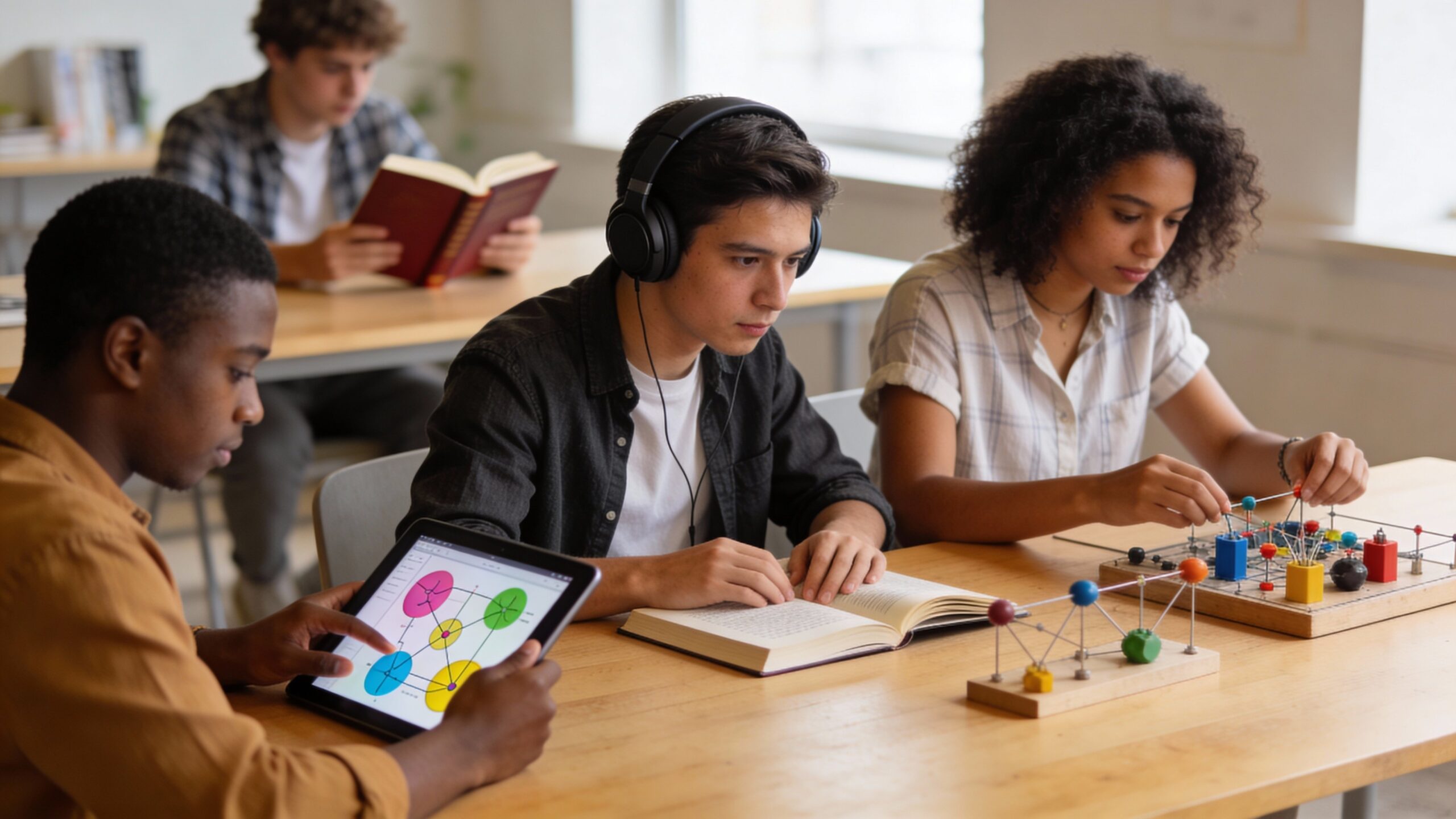
Learning is one of the most fascinating abilities of the human mind. From infancy to adulthood, we absorb information through countless experiences—watching, listening, moving, experimenting, and reflecting. Yet, not everyone learns in the same way. Some people understand ideas instantly when they see a diagram, others when they hear an explanation, and others only when they physically try something themselves. These differences are often grouped into three classic learning styles: visual, auditory, and kinesthetic. Understanding these learning styles can transform the way you study, teach, and retain information. Whether you are a student, educator, parent, or lifelong learner, recognizing how you or others learn best can unlock faster comprehension, deeper understanding, and stronger memory. This guide explains visual, auditory, and kinesthetic learning in a simple, practical, and engaging way, without jargon or complexity.
A: They’re useful as preferences for study tactics, but most people learn best with a mix and strong methods like retrieval practice.
A: Try a three-way test: diagram it (visual), explain it (auditory), and practice it (kinesthetic). Notice what helps you recall later.
A: No—use your preference to get started, then add other modes to strengthen memory.
A: Replace rereading with self-quizzing for 5–10 minutes at the end of each session.
A: Talk through your notes, teach them out loud, or record short summaries yourself.
A: Use physical models, move note cards, act out processes, or practice with realistic scenarios.
A: Kids often benefit from multisensory learning, but the biggest gains come from clear structure, practice, and feedback.
A: Highlighting boosts recognition, not recall. Turn highlights into questions and test yourself instead.
A: If you can explain it from memory 24 hours later and solve a new problem, it’s working.
A: Visual: one-page map. Auditory: 60-second teach-back. Kinesthetic: practice problem or real example.
What Are Learning Styles and Why Do They Matter?
Learning styles refer to the preferred ways individuals process and retain information. While everyone uses multiple senses to learn, most people naturally lean toward one dominant approach. Learning styles do not limit intelligence or potential; instead, they highlight how the brain most efficiently absorbs knowledge.
Understanding learning styles matters because it helps you customize study methods, teaching approaches, and communication strategies. When information is presented in a way that matches a learner’s preference, the brain processes it more easily, leading to faster understanding and better long-term retention. Conversely, when information is delivered in a mismatched way, learning may feel slow, frustrating, or confusing.
Although modern research suggests that people are flexible and benefit from multimodal learning, the visual-auditory-kinesthetic framework remains a powerful tool for self-awareness and practical study strategies.
Visual Learning: Understanding Through Seeing
Visual learners process information best through sight. They prefer images, diagrams, charts, videos, written notes, and spatial layouts. When visual learners read a textbook or watch a demonstration, they often create mental pictures to understand concepts.
Visual learning is deeply connected to how the brain interprets patterns, shapes, and spatial relationships. Many visual learners recall information by remembering where it appeared on a page or how it looked in a diagram. For them, a colorful chart or a flowchart can be far more memorable than a spoken explanation.
In daily life, visual learners often enjoy drawing, reading, organizing information visually, and watching videos or presentations. They may take detailed notes, highlight key points, or use mind maps to structure information. When solving problems, they often visualize steps or outcomes before acting.
Visual learning can be especially effective for subjects that involve structure and relationships, such as mathematics, science, geography, design, and architecture. However, visual learners can benefit from applying visualization techniques to any subject, including history, language, and psychology.
How Visual Learners Study Best
Visual learners thrive when information is presented in a clear and organized visual format. Color-coded notes, charts, diagrams, timelines, infographics, and illustrated explanations help them grasp complex ideas quickly. Watching demonstrations, documentaries, and instructional videos can also reinforce understanding.
When studying, visual learners often benefit from rewriting notes, creating concept maps, sketching diagrams, and highlighting key points. Visualization techniques such as imagining scenes, processes, or structures can improve memory and comprehension. Even turning abstract concepts into simple mental pictures can make learning more intuitive and enjoyable.
Auditory Learning: Understanding Through Listening
Auditory learners process information best through sound. They learn effectively by listening to explanations, discussions, lectures, podcasts, and verbal instructions. For auditory learners, hearing information can be more impactful than seeing it written down.
The auditory learning style relies on the brain’s ability to process language, tone, rhythm, and verbal patterns. Auditory learners often remember conversations, lectures, and instructions more easily than written notes. They may repeat information aloud to reinforce memory and often prefer group discussions or teaching others verbally.
In daily life, auditory learners often enjoy music, conversations, storytelling, debates, and listening to audiobooks or podcasts. They may talk through problems, read aloud, or explain ideas verbally to clarify their understanding.
Auditory learning is particularly helpful for language learning, public speaking, literature, and communication-based subjects. However, auditory learners can apply listening-based strategies to any topic.
How Auditory Learners Study Best
Auditory learners benefit from listening to lectures, recordings, and discussions. Reading notes aloud, using text-to-speech tools, and participating in study groups can enhance comprehension. Explaining concepts to others or teaching a topic verbally is one of the most powerful learning methods for auditory learners.
Recording lectures and replaying them, listening to educational podcasts, and using rhythmic or musical mnemonics can also improve retention. Talking through problems, summarizing information verbally, and engaging in debates or discussions help auditory learners deepen their understanding.
Kinesthetic Learning: Understanding Through Doing
Kinesthetic learners, also known as tactile or hands-on learners, process information best through movement, physical activity, and direct experience. They learn by doing rather than watching or listening.
Kinesthetic learning is connected to the brain’s motor and sensory systems. These learners remember actions, experiences, and physical sensations more than words or images. They often struggle with long lectures or static study sessions but excel when they can interact physically with the material.
In daily life, kinesthetic learners often enjoy sports, crafts, experiments, building projects, cooking, acting, and any activity involving movement or hands-on engagement. They may fidget, walk while thinking, or use gestures when explaining ideas.
Kinesthetic learning is especially effective in science experiments, physical education, engineering, medical training, and any subject that involves practice and real-world application. However, kinesthetic learners can apply movement-based techniques to any subject.
How Kinesthetic Learners Study Best
Kinesthetic learners benefit from hands-on activities, experiments, simulations, role-playing, and interactive learning tools. Writing notes by hand, using physical objects or models, acting out scenarios, and practicing skills repeatedly help reinforce memory.
Studying while moving, such as walking while reviewing flashcards or using gestures to explain concepts, can enhance learning. Creating physical projects, building models, conducting experiments, and practicing real-life applications of concepts make learning more engaging and memorable.
Are Learning Styles Fixed or Flexible?
While people often identify strongly with one learning style, most individuals use a combination of visual, auditory, and kinesthetic methods. Learning styles are not rigid categories but preferences that can change over time and vary by subject.
For example, a person may prefer visual learning for mathematics, auditory learning for languages, and kinesthetic learning for sports or science experiments. The brain is highly adaptable, and combining multiple learning styles often leads to the best results.
Modern educational research suggests that using multiple senses—seeing, hearing, and doing—creates stronger neural connections and improves long-term retention. Therefore, understanding learning styles is not about limiting yourself to one method but about leveraging your strengths while integrating other approaches.
The Science Behind Visual, Auditory, and Kinesthetic Learning
Learning styles are rooted in how the brain processes sensory information. Visual learning involves the occipital and parietal regions responsible for visual perception and spatial reasoning. Auditory learning involves the temporal lobes and language centers that process sound and speech. Kinesthetic learning involves motor cortex regions, sensory pathways, and the cerebellum, which coordinate movement and physical sensations.
When information is processed through multiple sensory channels, the brain creates more connections, making the information easier to recall. For example, watching a demonstration, listening to an explanation, and performing the task yourself engages multiple brain systems, leading to deeper learning.
This is why multimodal learning—combining visual, auditory, and kinesthetic methods—is often more effective than relying on a single style.
How to Identify Your Learning Style
Identifying your learning style involves observing how you naturally prefer to learn and remember information. Think about situations where you learned something quickly and effortlessly. Did you understand best by reading, listening, or doing?
If you remember diagrams, pictures, and written notes easily, you may lean toward visual learning. If you recall conversations, lectures, and spoken explanations, auditory learning may be your strength. If you learn best through hands-on practice, experiments, or physical activities, you may be kinesthetic.
However, most people fall somewhere in between and benefit from a mix of approaches. Self-awareness allows you to tailor study strategies and improve learning efficiency.
Applying Learning Styles to School and Education
In traditional classrooms, teaching often emphasizes visual and auditory methods, such as textbooks and lectures. Kinesthetic learners may struggle in these environments unless hands-on activities are included. Educators who incorporate visual aids, discussions, and interactive activities can engage all learning styles.
Students who understand their learning preferences can adapt study methods accordingly. Visual learners can create diagrams and color-coded notes. Auditory learners can record lectures and participate in discussions. Kinesthetic learners can build models, conduct experiments, or practice real-world applications.
Integrating all three styles creates a more inclusive and effective learning environment.
Learning Styles in Professional and Adult Learning
Learning styles are not limited to childhood or school. Adults continue to learn throughout life, whether through professional training, hobbies, or personal development. Understanding learning styles can improve workplace training, skill development, and lifelong learning.
For example, visual learners may prefer manuals, diagrams, and dashboards. Auditory learners may prefer workshops, discussions, and audio training materials. Kinesthetic learners may prefer simulations, practice exercises, and hands-on training sessions.
Organizations that offer multimodal training often see higher engagement, better retention, and improved performance.
Using Learning Styles to Improve Memory and Retention
Memory is closely linked to how information is encoded. Visual, auditory, and kinesthetic methods each create different memory traces in the brain. Combining them strengthens recall.
Visual memory is enhanced by images, colors, and spatial layouts. Auditory memory is strengthened by repetition, rhythm, and verbal explanation. Kinesthetic memory is reinforced through physical action and experience.
For example, learning a new concept by reading about it, listening to an explanation, and practicing it physically creates multiple pathways in the brain. This redundancy makes forgetting less likely and recall more reliable.
Common Misconceptions About Learning Styles
One common misconception is that people should only use their preferred learning style. In reality, using multiple learning methods is more effective. Another misconception is that learning styles determine intelligence or potential. Learning styles reflect preferences, not abilities.
Another myth is that learning styles are fixed and unchangeable. The brain is highly adaptable, and people can develop skills in all learning modalities. Learning preferences can evolve with experience, age, and subject matter.
Understanding learning styles should empower learners, not restrict them.
How to Combine Visual, Auditory, and Kinesthetic Learning
The most powerful learning occurs when all three styles are integrated. For example, when learning a scientific concept, you might watch a diagram, listen to an explanation, and conduct an experiment. This multisensory approach creates deeper understanding and long-lasting memory.
Combining learning styles can also make studying more engaging and enjoyable. Visual aids keep learning organized, auditory explanations add clarity, and kinesthetic activities make learning interactive and memorable.
Students, teachers, and professionals can design learning experiences that incorporate all three styles to maximize effectiveness.
Learning Styles in the Digital Age
Modern technology offers endless opportunities for visual, auditory, and kinesthetic learning. Videos, infographics, podcasts, interactive simulations, virtual reality, and gamified learning platforms make it easier than ever to engage multiple senses.
Online courses often include video lectures, audio explanations, quizzes, and interactive projects, allowing learners to choose methods that suit their preferences. Digital tools can personalize learning and support diverse learning styles.
As technology evolves, multimodal learning is becoming the norm rather than the exception.
Why Understanding Learning Styles Can Change Your Life
Understanding how you learn best can transform your academic performance, career development, and personal growth. It can reduce frustration, increase confidence, and make learning faster and more enjoyable. When you align study methods with your learning preferences, you can absorb information more efficiently and retain it longer. When you integrate multiple learning styles, you unlock the full potential of your brain. Learning styles are not just an educational concept; they are a roadmap to lifelong learning success.
Learning Styles Made Simple
Visual, auditory, and kinesthetic learning styles offer a simple and powerful way to understand how people process information. Visual learners learn best through seeing, auditory learners through listening, and kinesthetic learners through doing. Most people use a combination of all three, and combining them leads to the strongest learning outcomes.
By recognizing your learning preferences and experimenting with different study methods, you can make learning more effective, engaging, and enjoyable. Whether you are studying for school, improving professional skills, or exploring new interests, understanding learning styles can help you learn smarter, faster, and better.
Learning is not one-size-fits-all. It is a dynamic, multisensory journey—and understanding how you learn is the first step to mastering anything.